Why And How To Taste Honey? Sensory Analysis
    3Bee approachHistoryTastingFabrizio

    Why And How To Taste Honey? Sensory Analysis

    We are all used to considering honey as a sweetener that can well replace sugar, but we often forget that honey is a precious food that can be appreciated for its many characteristics and properties.

    Read the article
    25/03/2020Of 3Bee, Elena Fraccaro
    1547 Views
    25/03/2020Of 3Bee, Elena Fraccaro
    1547 Views

    3Bee's approach to biodiversity protection
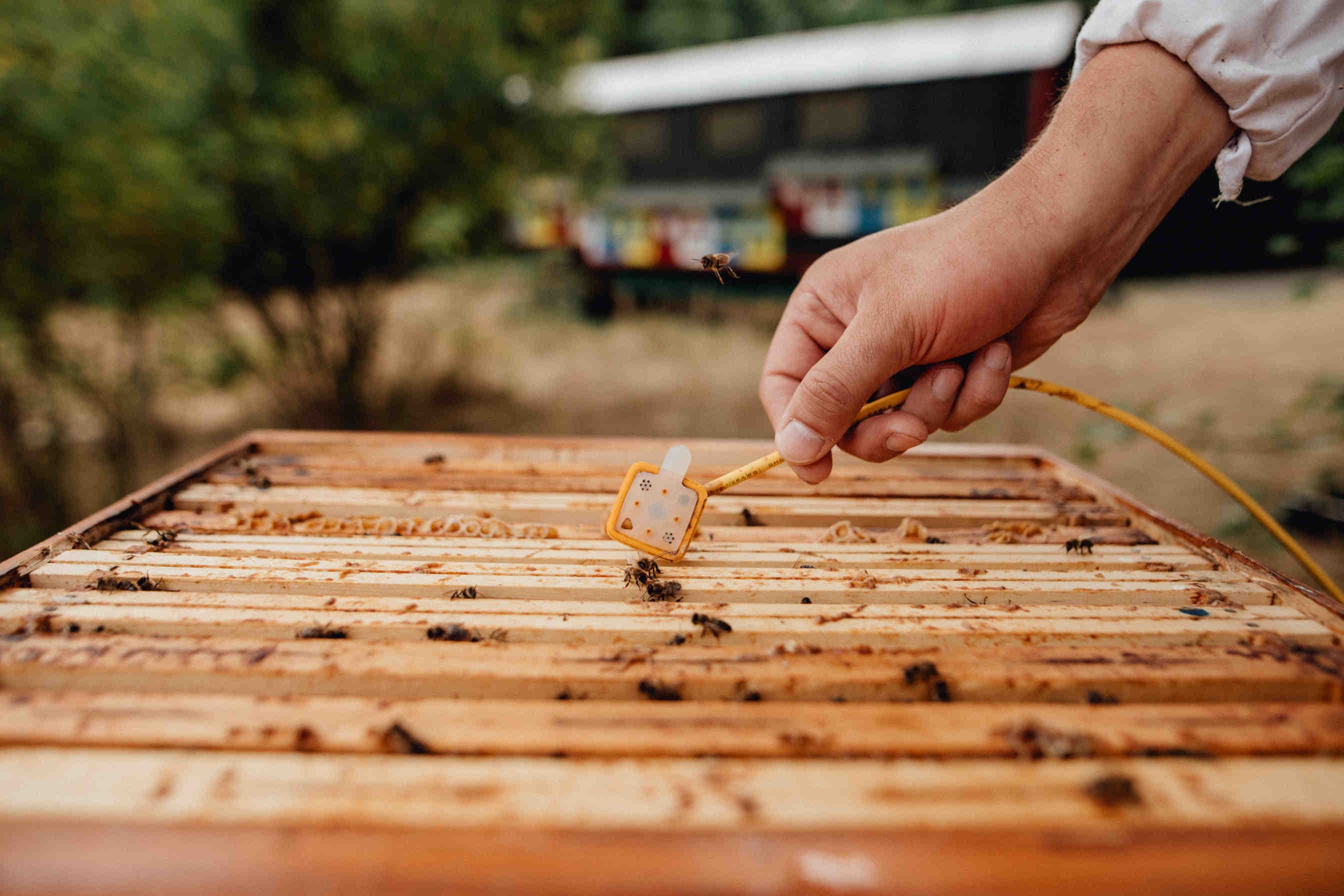
    3Bee is the Nature Tech company that develops technologies for the protection of biodiversity. 3Bee Hive-Tech is 3Bee's first system for analysing the health and 'starvation' status of honeybees, environmental pests par excellence. Over time, we have developed other technologies to study and monitor all the pollinating insects and created more than 200 Oases of Biodiversity with thousands of nectariferous plants to provide them with nourishment. In this way, we want to create a virtuous circle: our beekeepers are transformed by necessity into Oasis growers and promoters of environmental biodiversity. We do not encourage massive production and intensive breeding, which have a negative impact on biodiversity and pollinators. We do, however, recognise the value of honey as a valuable symbol of the biodiversity of an environment and a tool for disseminating the commitment and protection of an area, to be consumed sparingly and with respect for the life cycle of these insects.

    3Bee Hive-Tech

    A bit of history

    The assessment of honey qualities has always been extremely important for the marketing of this product, from antiquity to the post-World War II period, when the techniques that we can use today were not available. However, we can only begin to speak of an institutionalisation of this practice in 1978. In that year, Michel Gonnet, a honey expert, and Gabriel Vache, an expert taster, promoted these courses at the Hyères vocational training centre. In 1979, these same courses were also organised in Italy, in the Finale Ligure area. The need to homogenise the language and methods of describing honey led, in 1988, to the creation of the National Register of Experts in Sensory Analysis of Honey, the first in Europe.

    XNatura

    The importance of sensory analysis and tasting

    At the Italian level, one of the most important figures in the field of honey sensory analysis is Lucia Piana, author also of numerous publications on the subject. According to Piana, the main objectives of sensory analysis are quality improvement and product enhancement. At the quality level, it allows the identification and definition of standardised parameters to identify the botanical origin and quality of honey. It also supports the producer in the various stages of product production and packaging. At the level of valorisation, the aim is to acquaint the final consumer with the product, allowing him to know its characteristics and peculiarities, which are often far removed from the logic of uniformity and homogeneity sought by large-scale distribution.

    Taster's word

    We are lucky enough to be able to talk about honey sensory analysis with our beekeeper and collaborator Fabrizio, a member of the Honey Sensory Analysis Register. Hi Fabrizio, let's start right at the heart of the matter: what is honey tasting or sensory analysis? What does it consist of? "Honey sensory analysis is a honey tasting that we can define as professional, in the sense that standardised evaluation methods are used to assess the quality of the product. In particular, for honey, we have an analysis divided into several stages: the visual analysis stage, where the colour of the honey and how it looks is analysed; the olfactory analysis, when the honey is smelled and its odours are recorded; and the tasting stage, where the honey is tasted to assess its aroma, flavour, persistence and consistency."

    XNatura

    What is the difference between these four parameters?

    "The aroma is perceived from the retro-nasal area, where there are olfactory cells that intercept the odour molecules that are released from food in the mouth. It is something unrelated to the scent itself and, in sensory analysis, is described with adjectives such as: intense, not very intense, odour-like, faint, medium, strong, floral, fruity... The taste, on the other hand, is the sensation perceived by the sense of taste, i.e. perceived with the taste receptors on the tongue. We are all familiar with the flavours we can perceive and they are: sweet, bitter, salty, sour and umami (the savoury, in other words). The persistence concerns the length of time the taste-olfactory sensations remain in the mouth and in the retro-nasal areas. In this sense, we can have honeys that are not very persistent or, on the contrary, very persistent. The consistency, finally, concerns the tactile examination of the honey: is it liquid? Is it crystallised? If so, what grain does it have?"

    3Bee

    How complex is it to taste the different types?

    "Quite a lot, I would say they are the most difficult degastings, much more so than with wine and oil. This is because with honey, each year and each place play their part and it is practically impossible to obtain a standardisation of the product. For example, a millefiori made in Piedmont will never be the same as one produced in Tuscany. Even in the same region, however, enormous differences can arise. To this we must add that some types of honey are weak to the nose and we do not have palates trained enough to recognise the various types, we only smell the sweet note without being able to grasp all the nuances. Olfactory analysis is very difficult. On average, out of the 12 most popular Italian honeys, only 3 or 4 are recognised, so it is very easy to get confused."

    So the job of taster is a job for the few?

    "There are just over 300 members in the Register, not just a lot. The secret is that you have to, as in everything, do a lot of training. There are those who are better at it, of course, and are able to give precise descriptions of the sensations that each different type of honey gives. The less fortunate will have to study more. A good exercise is to retrieve honeys of different qualities and from different regions in order to be able to compare them and understand the differences. We know that every honey is a result of where it is produced, so comparing honeys from different regions is great to train our palate and make us realise that what we think is the 'flavour par excellence' is not quite so."

    So one cannot improvise as a taster?

    "No, absolutely! Each year, specific courses are organised. It starts with an introductory course. If you want to continue along this path, there is then a Level I course and a final course with a final exam, which is held in Bologna at the CREA. If you pass this examination, you will be enrolled in the Register. In order to maintain this 'status', you must carry out at least one refresher activity over the following 2 years or take part as a judge in at least one honey judging competition."

    Do we need any special tools?

    "At official tastings, honey (in small quantities) is presented in a ballon, a special goblet glass with a maximum capacity of 150ml. These particular glasses allow the honey's aromas to be released and facilitate olfactory examination. A spatula or plastic spoon is then needed to stir the product and facilitate the release of odours. If several honeys are to be tasted, it may be useful to have a green apple (possibly sour) or a glass of water at hand. This allows you to 'cleanse your mouth' and not confuse the flavours."

    Who chooses the honey descriptions?

    "To understand what we are talking about, we need a common language, so that our description is understandable. To guide tasters, what is called the circle of odours and aromas has been developed. In the innermost circle we find the 7 families of the main odours of honey, namely floral, fruity, warm, aromatic, chemical, vegetable and animal. Sub-categories are then identified for each family, each of which has specific indications to make it clear what we are really talking about. For example, a honey that is defined as warm roasted will have a smell and aroma reminiscent of hazelnuts or roasted almonds." Fabrizio performed a live sensory analysis of 5 different types of honey for 3Bee, guiding us through this mysterious and fascinating world. You can review the video here.

    Is it important to know how to taste honey? If so, why?

    "It is very important, both for beekeepers and consumers. For the beekeeper, it is essential to really know the product he is going to market, both to present a compliant product and not incur penalties and to fully value it. The consumer, on the other hand, can learn to really know the product he brings to the table and be more aware of it. One of the main objectives of sensory analysis is precisely to raise awareness of honey as a foodstuff, to make people appreciate all its facets and characteristics, while also educating the consumer to appreciate those peculiarities typical of honey, such as the impossibility of having honeys that are always the same. Quoting Marco Accorti, 'every honey is potentially different from another due to differences that are beyond human control. Tasting honey is a gamble'. This is what sensory analysis is for, to make people accept a bet and give them the tools to play it out to the end."

    25/03/2020Of 3Bee, Elena Fraccaro
    1547 Views
    Newsletter
    newsletter
    Subscribe to the Blog about bees and biodiversity
