Sperm whale alphabet: new details on their language
    CommunicationSperm whalesClickStudio

    Sperm whale alphabet: new details on their language

    For millennia, the fascination of whales has captured human curiosity, turning these ocean giants into enigmatic inhabitants of the deep sea. Thanks to machine learning algorithms, we are getting closer and closer to understanding these magnificent marine inhabitants.

    Read the article
    14/07/2024Of 3Bee, Alessia Mircoli
    488 Views
    14/07/2024Of 3Bee, Alessia Mircoli
    488 Views

    The importance of communication


    communication is a fundamental factor in everyday life as it plays a particularly important role in social behaviour. These, in fact, require the ability to generate and understand many different messages. To enable the communication of many distinct meanings, humans access a large inventory of basic sounds, called phonemes, which are sequenced to produce an unlimited set of distinct expressions. The contextuality and combinatoriality have few analogues in communication systems outside of human language. Understanding, therefore, how and when human communication develops can help us better understand intelligence in other life forms.

    Comunicazione

    The complex communication of sperm whales

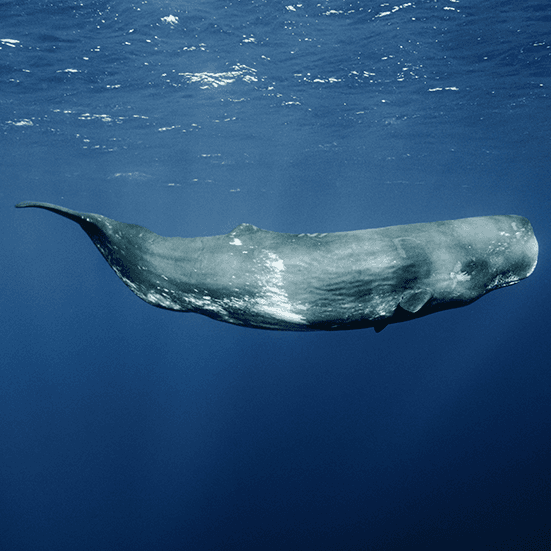
    Cetaceans represent a group of primary importance in the study of evolution and the development of sophisticated communication systems. Among them, sperm whales stand out for their complex social behaviour, foraging strategies and group decision-making. These majestic creatures dive up to a depth of 2,500 m and can remain underwater for up to two hours. Under these conditions, sight becomes virtually useless due to the lack of light, so thecommunication relies mainly on sounds. The sperm whale uses its nasal apparatus, the largest sound-emitting instrument in the animal kingdom, to produce sounds. These are generated in the distal air sac, located at the anterior margin of the head. They then travel posteriorly to the phonic lips, through the spermaceti, and then reach the frontal air sac. From here, they are reflected forward and emitted from the lower and anterior part of the head.

    capodoglio
    XNatura

    How do sperm whales communicate?

    To communicate they use a series of codes called 'tails', short sequences of between 30 and 40 clicks, which vary greatly in structure depending on the communicative context. These clicks are exchanged during socialisation or during long, deep dives for foraging. Scientists, to date, have identified a finite repertoire of queue types in the sperm whale's communication system, each defined by a characteristic sequence of interval inter-clicks (ICIs). The study allowed decoding the "sperm whale phonetic alphabet", revealing sophisticated structures in the communication of these animals similar to human phonetics and communication systems in other animal species.

    Lettere

    The study

    To conduct the research, the scholars utilised a vast dataset provided by the Dominica Sperm Whale Project (DSWP), which is currently the most extensive archive of information available on sperm whales. This valuable repertoire includes records from the Eastern Caribbean clan, numbering almost 9000 distinct tails. The experiments were also conducted using acoustic bio-recording tags deployed on the clan's specimens between 2014 and 2018. These allowed the intricate details of the whales' vocal patterns to be captured. In addition to the data collected, the team employed a combination of algorithms for click recognition and classification. It found, thus, that sperm whales use 18 different click patterns (i.e. 18 different tails) to communicate and not 21 as previously thought. However, these can be altered to give rise to further levels of complexity.
    Capodoglio
    XNatura

    The results

    The researchers, as mentioned earlier, have identified a "phonetic alphabet of the sperm whale", in which different elements, such as "rhythm", "tempo", "rubato" and "ornamentation", interact to form a variety of distinct tails. For example, whales systematically modulate certain aspects of their tails according to the context of the conversation, such as variations in the duration of calls or the addition of ornamental clicks. Even more surprisingly, scholars have discovered that key elements of these codes can be composed in a combinatorial manner, allowing whales to build a vast repertoire of unique vocalisations. Individuals of this species are able to emit a wide range of codes during prolonged interactions, thus displaying a vast repertoire of distinct vocalisations.

    capodoglio
    3Bee

    The limitations of the study

    The researchers state that this research examines the basic structural elements of the sperm whale communication system, but not the semantics. Whether sperm whales are able to realise the so-called 'pattern duality' remains to be clarified. This phenomenon occurs when elements, which on their own are meaningless, are combined to create increasingly articulate and complex ideas. For example, in English, the sounds 'ba' and 'na' do not have meaning in isolation, but together they form the word 'banana'. Moreover, several words together can construct entire phrases. The research team is not entirely certain that the codes and their variations in sperm whale calls constitute actual sentences, but there are indications that the sounds emitted by these cetaceans may encode more than one meaning.

    Limiti

    Future perspectives

    It is evident, therefore, that this study provides a basis for future research into the semantics of whale calls. Indeed, it remains to be elucidated how elements such as rhythm, tempo, ornamentation and rubato can convey specific communicative intentions, potentially offering important insights into the 'duality of pattern', a linguistic phenomenon previously thought to be exclusive to human language. Nevertheless, this work represents a significant step forward in the understanding of sperm whale llanguage.

    futuro

    Possible uses of this discovery

    The study's lead author claims that an intriguing aspect of their research lies in its possible analogy with a hypothetical scenario of contact with alien species. They are faced with the challenge of understanding a species that lives in an environment and follows completely different communication protocols, where interactions are radically different from human norms. What this study sought to do is to explore the underlying meaning of sperm whale communication, attempting to decode a communication system that has evolved naturally within unique biological and environmental constraints. In essence, this work could provide a foundation for understanding how an "alien civilisation" might communicate, offering insights into the development of algorithms or systems capable of interpreting completely unknown forms of communication.

    capodoglio oceano
    14/07/2024Of 3Bee, Alessia Mircoli
    488 Views
    Newsletter
    newsletter
    Subscribe to the Blog about bees and biodiversity

    Frequently Asked Questions

    Do you have any doubts or other curiosities about this article? Here you will find some insights