Swarming Control
    ImportanceTechniquesTimingHive-Tech

    Swarming Control

    Swarming is an absolutely positive natural phenomenon, it is the form of reproduction of the beehive superorganism: from one family, two are formed and the species propagates. It is swarming time, what to do?

    Read the article
    14/05/2020Of 3Bee, Elena Fraccaro
    398 Views
    14/05/2020Of 3Bee, Elena Fraccaro
    398 Views

    Why is swarming control necessary?

    However, preventing hives from swarming is crucial for good honey production, especially for spring honeys. In fact, if a hive swarms, the number of bees remaining will be about half and most of them will be young bees, not yet able to forage. So there is a drastic drop in the working force of the family. Even if you recover the swarm that has left, it will have to build all the new combs, with a great expenditure of energy and work, and in any case even two half-families always produce less than one strong family. If it is then not even possible to recover the swarm that has left, the loss is even heavier. For these reasons, efficient swarming control is indispensable for the beekeeper.
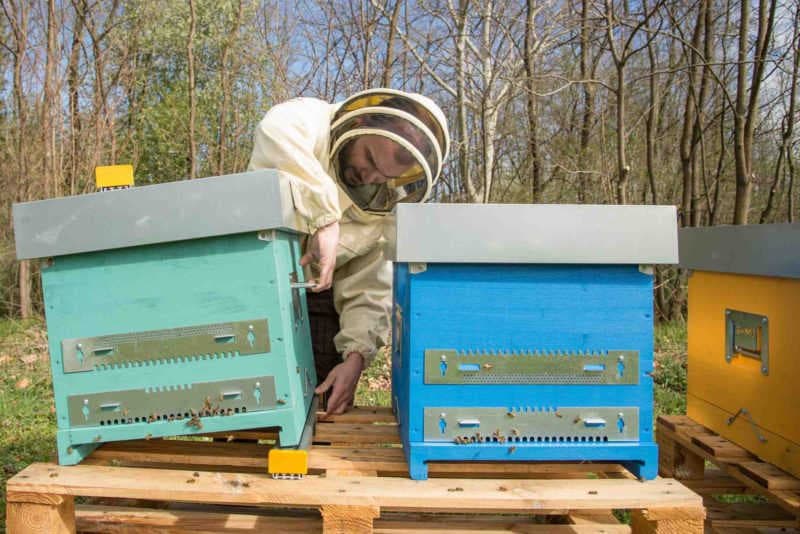
    Swarming control: techniques and methods

    Creating space - As a first way of controlling swarming, one can try to delay it by giving the bees space. You can give new frames to build, do balancing, put in the honeycomb, transfer the swarms to larger hives, make artificial swarms, but in all likelihood the bees will still want to swarm. And you can tell when the bees start building real cells. Then action must be taken or they will swarm. It is certain. Real cell removal - A somewhat laborious but extremely effective method to prevent swarming is to remove all the royal cells before the new queen hatches. If done well and regularly, swarming will not occur and the entire hive population will be available for production. Obviously the bees will rebuild them and we must remove them again until they stop building them. We must remove all the real cells in the hive at least once every 10 days.

    XNatura

    How often should cells be checked?

    To be sure of removing them all, one must check all the frames carefully and without bees on them and remove them. All of them, whether operated or not, large or small. It is important to check each side of the frame and also the edges. To remove the bees, simply shake the frame gently but firmly over the hive, causing the bees to fall in. It is important not to shake the frame outside the hive because if the queen is there, she will stay outside. Obviously they will immediately start breeding new royal cells. So the operation should be repeated at least every 10 days, but better every 7. The development time of a queen from egg to adult is 16 days, but bees can also raise a queen from a 3-day-old worker larva. Three days of larva plus the 3 days that the egg lasted makes 6 days, so in this case, if the bees raise a queen from a 3-day-old worker larva after 10 days the new queen will be born and swarming will take place.

    Help from 3Bee systems

    With the monitoring systems for 3Bee hives you can keep an eye on the status of your hive and its production level at all times. Thanks to the internal sensors, you can not only monitor the weight and its variation, but also the tindoor temperature, humidity and sound. By analysing the sound intensity emitted by bees, one can understand their activity and, in some cases, even detect possible swarming. High and abnormal sound intensity peaks, in fact, herald a forthcoming swarming, allowing you to intervene in good time.

    Help from 3Bee systems
    XNatura
    14/05/2020Of 3Bee, Elena Fraccaro
    398 Views
    Newsletter
    newsletter
    Subscribe to the Blog about bees and biodiversity