Criteri ESG e Corporate Governance
    GovernanceSustainabilityGovernanceImprese

    Criteri ESG e Corporate Governance

    ESG criteria have relevance within a company's corporate governance systems and are a crucial factor in distinguishing organisations that consider sustainability at the core of their business model from those that approach it for external communication reasons.

    Read the article
    12/10/2023Of 3Bee, Elena Fraccaro
    1607 Views
    12/10/2023Of 3Bee, Elena Fraccaro
    1607 Views

    Corporate Governance and Sustainability Management

    Integrating sustainability within corporate governance systems involves defining (and sometimes creating from scratch) bodies, rules and processes that enable the company to effectively manage its social and environmental impact. This allows one to acquire the ability to identify and analyse opportunities and risks related to social trends, as well as to activate the decision-making processes necessary to align business activities with these trends. To this end, there are models that provide an overview of the system that can be used to achieve the ESG objectives in Governance.

    La corporate governance e la gestione della sostenibilità

    Sustainability and corporate 'purpose

    To fully understand corporate governance and sustainability management models, it is essential to identify the 'purpose' of an organisation as the starting point. Governance systems enable organisational solutions to achieve and improve sustainability goals. To this end, a model that provides a general overview of the system has emerged from the scientific research activities carried out in recent years within the Observatory on Sustainability Governance, promoted by Sustainability Makers (former CSR Manager Network) and by ALTIS-Alta Scuola Impresa e Società dell'Università Cattolica del Sacro Cuore. Pictured left is model 1 from the 2022 publication "La corporate governance e la gestione della sostenibilità: forme e strumenti by Maria Cristina Zaccone, Marco Minciullo and Matteo Pedrini"
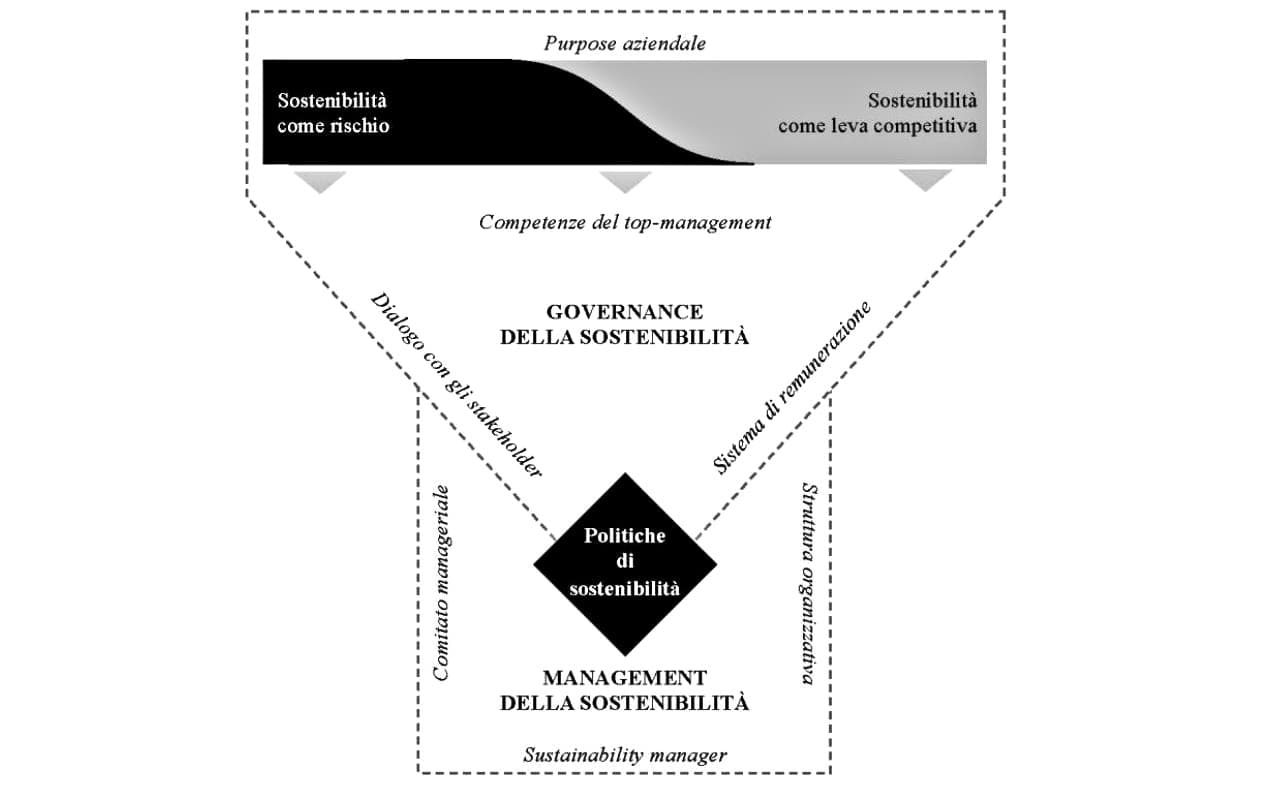
    Modello della governance e gestione della sostenibilità
    XNatura

    The governance of sustainability

    In order to analyse "sustainability governance", it is useful to initially examine the specific sustainability governance arrangements that may be adopted by companies. Although no universally accepted classification currently exists, it is possible to identify the forms of governance commonly adopted by many companies globally, particularly large and/or listed ones. The classification of forms of governance adopted by the Observatory (Minciullo, 2019) can be summarised as follows: starting with the Sustainability Committee and the Sustainability Committee with more delegated powers (Audit and Risk and Sustainability Committee; Nomination and Sustainability Committee), followed by the Interim Board Committee with more delegated powers (Audit and Risk Committee); Supervisory Board and the Managerial Task Force.

    La governance della sostenibilità

    Corporate sustainability policies

    The sustainability policies are the result of decisions made by top management regarding social-environmental issues. These policies vary widely depending on how the company views sustainability as part of its purpose. In companies where sustainability is considered a risk to be managed, sustainability policies seek to predict future scenarios and the impacts of key social, environmental and economic trends. Usually, they promote policies and sustainability practices that are primarily oriented towards regulatory compliance and may build on actions taken by competitors, although this approach creates limited value for the company. On the other hand, companies that consider sustainability as a competitive advantage define sustainability policies and plans consistent with their business strategy. In this context, 3Bee supports companies in achieving ESG goals.

    XNatura

    Sustainability management

    The management of sustainability is composed of three variables: the management sustainability committee, also called the sustainability task force, is an inter-functional committee that brings together managers from different functional areas in order to coordinate the sustainability activities involving several corporate functions and to manage their implications; the organisational function dedicated to sustainability is specifically set up to implement sustainability-related activities, usually under the leadership of the sustainability manager; the sustainability manager is the figure in charge of the realisation and management of sustainability initiatives, as well as of the coordination with top management and other corporate functions.

    Il management della sostenibilità
    3Bee

    Importance of stakeholders in governance

    Another key component of the sustainability governance system is the stakeholder dialogue, which reflects how a company considers the expectations of all stakeholders involved in its activities and how it chooses to relate to them. This dialogue is crucial to identify, understand and fully integrate the needs of the different stakeholders with whom the company interacts. The company's "purpose" defined with regard to sustainability also influences how it engages in dialogue. Corporate executives who view sustainability as a risk to be managed and monitored focus primarily on listening in order to understand the reporting priorities, emerging expectations and any signs of dissatisfaction among key stakeholders. The most common dialogue tools in this case are interviews and questionnaires.

    Fifth edition: Sustainability Governance Observatory

    Presented by Sustainability Makers and ALTIS Graduate School of Sustainable Management of the Università Cattolica del Sacro Cuore, the fifth edition of the "Sustainability Governance Observatory". This study, launched in 2013, aims to monitor the integration of sustainability in corporate governance in Italy and Europe. The study analysed, a sample of 1400 leading stocks worldwide, including relevant company data and documents such as the corporate governance report, the sustainability report, the remuneration report and the curricula vitae of board members.

    Osservatorio Governance della sostenibilità

    ESG and corporate commitment to sustainable governance

    The results of the Observatory's study 'Sustainability Governance' showed an increasing number of sustainability committees within the boards of directors of Italian and French companies. According to the study, some 92.5 per cent of the large companies listed in these two countries demonstrate a growing commitment to sustainable governance and have endo-consiliar committees with sustainability mandates in the company organisation. In contrast to Nasdaq-listed companies in the US, only 11% have a sustainability committee.

    Sustainability and improved economic performance

    The study emphasises that the adoption of sustainability governance through ESG criteria does not always guarantee an improvement in the economic, environmental and social performance of companies. Matteo Pedrini, Scientific Director of Sustainability Makers, points out that "Sustainable transition requires a wide range of skills, which are unfortunately still absent in many cases or not very widespread: the picture that emerged might seem alarming, considering the urgency of integrating sustainability into the business model and the way companies operate, in the direction of environmental transition and social responsibility objectives". Pedrini explains that: "the role of the sustainability professional called upon to promote the training and development of sustainability skills among board members, for example through induction processes and consolidation of the sustainable culture among the various corporate functions, becomes increasingly strategic".

    Sostenibilità e miglioramento delle performance economiche

    Guidelines and the figure of the Sustainability Manager

    In order to adopt corporate sustainability through ESG criteria, there are reference guidelines, in 2010 published ISO 26000 'Guideline on Social Responsibility' which was the first to make explicit the issues of Social Responsibility. In June 2021, the Reference Practice UNI 109/2021 - Unregulated professional activities: professional profiles in the field of sustainability was established. In the development of corporate sustainability, an important figure comes into play: the "Sustainability Manager (SM)". This is a professional figure whose task is to ensure that the company adopts a business model and implements it through a value chain with positive social and environmental impacts. For this figure, training is crucial: this is where 3Bee comes in with the first online training course for sustainability professionals, Pills from the Oasis - the 3Bee Digital Academy. Want to learn more?

    Linee guida e figura del Sustainability Manager
    12/10/2023Of 3Bee, Elena Fraccaro
    1607 Views
    Newsletter
    newsletter
    Subscribe to the Blog about bees and biodiversity

    Frequently Asked Questions

    Do you have any doubts or other curiosities about this article? Here you will find some insights