Why?EvaluationsModeCage

    Brood Block: Biotechnology for Anti-Varroa Treatments

    Brood freezing is a situation where, within the hive, the queen's oviposition activity stops for a certain period of time. However, it is also a biotechnique practised by many beekeepers that allows a brood-free situation to be achieved.

    Read the article
    28/06/2019Of 3Bee, Elena Fraccaro
    811 Views
    28/06/2019Of 3Bee, Elena Fraccaro
    811 Views

    Why the brood block?

    Why is this technique used? The main reason is related to varroa control. Generally, artificial brood blocking is combined with summer, or winter, anti-varroa treatment with oxalic acid. This procedure allows treatment with oxalic acid in the absence of brood, maximising its acaricidal effect. We know, in fact, that oxalic acid only has an effect on foretic varroa, i.e. that found on the bees, and not on that inside the brood cells. The summer treatment prevents the further development and spread of the parasite. If no action were taken, the degree of infestation would, within a few months, reach an unsustainable level for the colony, whose survival would be seriously jeopardised.

    Assessments related to its use

    First of all, one must evaluate all the families that make up the apiary to be treated. Indeed, the same treatment must be carried out with the same timing within the same apiary. If this were not done, the risk of subsequent infestation would be very high. It must also be considered that brood blocking could have negative consequences if performed on families that are too weak or underdeveloped. Since the treatment is carried out in summer, and no later than mid-August, it may happen that the family then finds itself in a situation of poor importation that would prevent it from preparing properly for the colder season. Episodes of non-acceptance of the queen after caging may also occur, and for families that are already tried this could be detrimental. The timing of intervention is then crucial.

    XNatura

    The brood block: timing and modalities

    The concept behind this technique is very simple. The queen is prevented from laying any more eggs for a certain period of time, between about 19 and 24 days. At the same time, all the brood laid before caging will be allowed to flicker: there will only be adult insects and varroa will be concentrated on them. Finally, after the caging period, the queen is freed and treatment with oxalic acid is carried out. If, on the other hand, brood is still found after the release of the queen, it must be removed manually. This can be achieved in several ways. Let us look at them together.

    Brood block with cage

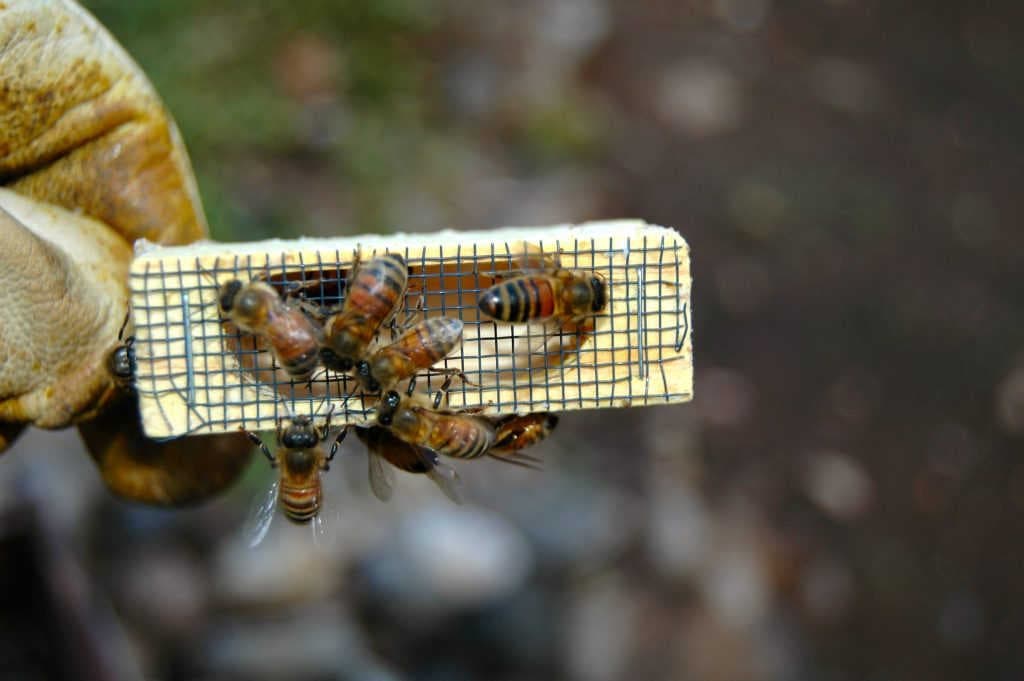
    One procedure involves the use of special cages, which are available on the market in various models. They range from the famous Chinese cage to the 'Scalvini cage' to the classic brood block cage. How is brood blocking implemented with this type of instrument? We proceed by capturing the queen and enclosing her, alone, in the special cage, which is placed in the combs of the nest. At the end of the enclosure period (19 to 24 days), she is released and treated with oxalic drip. The risk of enclosing the queen alone in a cage and interrupting her 'work' is linked to the poor diffusion of her pheromones. If these are in short supply within the hive, the other bees may breed new replacement royal cells.

    Brood block with cage
    XNatura

    Caging the Honeycomb

    For these reasons it is very often preferred to confine the queen in a whole nest honeycomb. Furthermore, leaving the queen a whole honeycomb for laying will attract varroa even more brood. Eliminating the 'infested' honeycomb and treating it should therefore have a more significant result. To cage the honeycomb, it is necessary to have special cages available, which are commercially available or can be constructed using a net that prevents the passage of the queen, but allows that of the workers. One can proceed in two different ways. One can pick up a honeycomb in advance and proceed with partial caging. Alternatively, one locates the honeycomb with the queen and cages it immediately or one can also choose an old honeycomb to be removed, shake out the bees and place the queen on it before actual caging.

    3Bee

    The trap frame

    This frame, the definitive 'trap frame', can have different fates after the enclosure period. As it is a varroa concentrate, it can be eliminated, especially if the wax is old and there is a need for replacement within the hive. If the honeycomb is still usable, the brood can be removed, e.g. with a jet of water, sanitised and reintroduced into the nest. Should one wish to maximise the anti-varroa trap effect, once the brood has been fully hatched one can remove the honeycomb, place the queen on another and proceed again with caging. This technique has many advantages, both in terms of resuming oviposition and the subsequent re-caging of the queen. Being in contact with a larger number of bees, there is greater circulation of her pheromone and acceptance also becomes easier.

    Brood block for orphaning

    Finally, we can talk about brood blocking by orphaning. In this context, one can proceed with brood blocking and simultaneous swarming or with brood blocking and queen exchange. These are particular techniques that refer to specific choices made by the beekeeper in conducting his business. In the case of queen replacement, this type of brood block may be dictated by the old age of the queen herself, who is no longer performing well and capable of guaranteeing family cohesion. To do this, the beekeeper may decide to leave everything to his bees or to intervene in some way. The beekeeper can in fact insert one or more selected cells into the orphaned families or intervene by inserting a queen that has already flickered, eliminating all the cells built up by the bees.

    Uses 3Bee monitoring systems

    We looked together at several techniques related to brood blocking implemented in preparation for anti-varroa treatment with dripped oxalic acid. As we have seen, timing and correct timing is crucial to optimise treatments to the maximum. Sometimes helping with a remote monitoring system of the hive can be essential in order not to thwart all one's efforts. Discover the full functionality of our 3Bee devices.

    28/06/2019Of 3Bee, Elena Fraccaro
    811 Views
    Newsletter
    newsletter
    Subscribe to the Blog about bees and biodiversity