Birdy: the XNatura® sensor that recognizes birds by their song
    Birdy in 3DHow it's madeHow it worksAgainst BirdNET

    Birdy: the XNatura® sensor that recognizes birds by their song

    Birdy is the XNatura® bioacoustic sensor that listens day and night and recognizes over 200 species of European birds. How it is made, how it works, why our model goes beyond BirdNET on real sounds, and how to bring it to your sites.

    Read the article
    20/10/2026Of 3Bee, Niccolò Calandri
    5 Views
    20/10/2026Of 3Bee, Niccolò Calandri
    5 Views

    Birdy in 3D, from design to forest

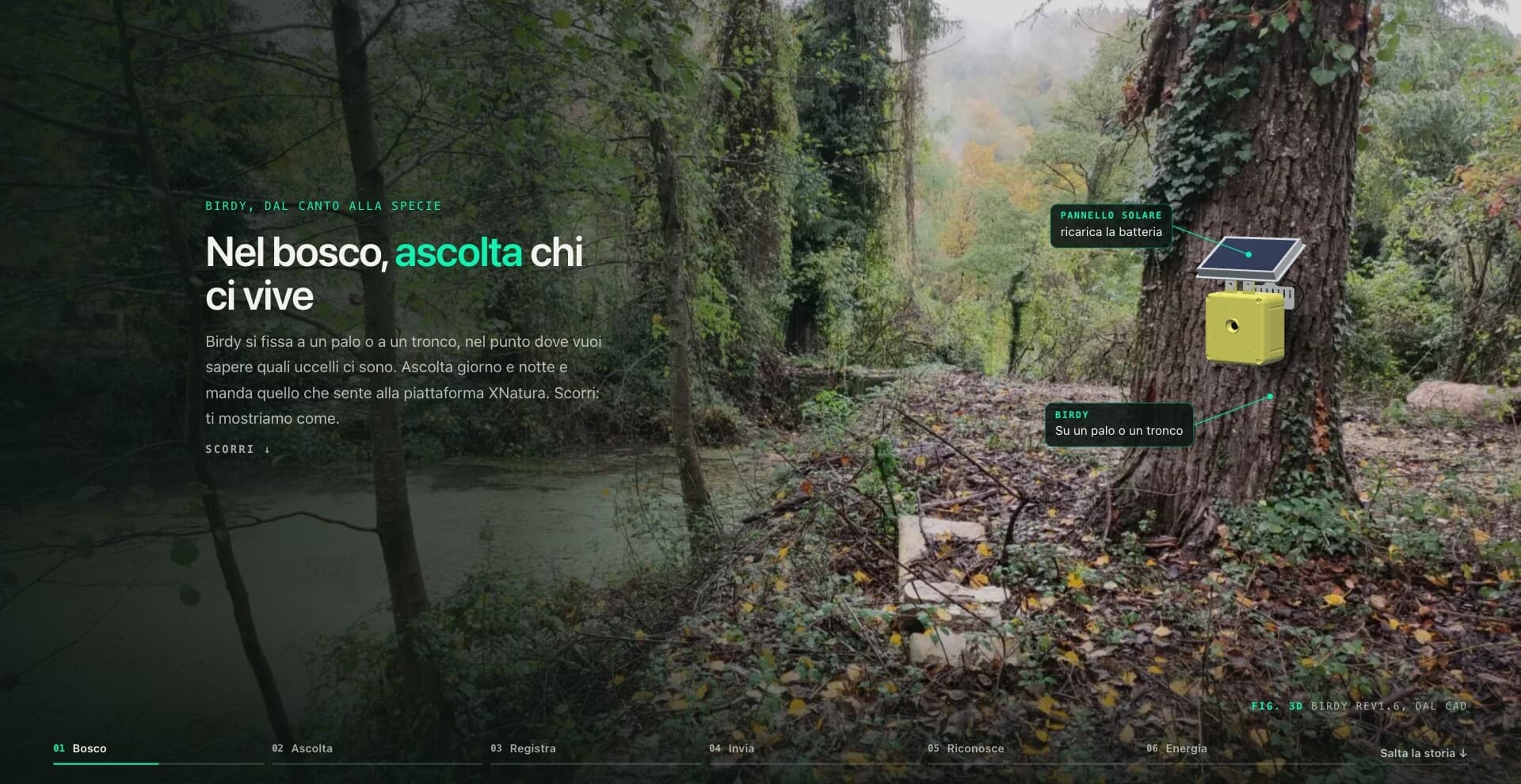
    This is Birdy, the bioacoustic sensor by XNatura® developed by 3Bee, reconstructed in 3D directly from its CAD project. It attaches to a pole or a tree trunk, at the point where you want to know which birds are there, and listens day and night without disturbing wildlife. Every song it records arrives on the XNatura® platform, where it becomes a recognized species, with the time, the location, and the audio to listen back to. In the video we retrace its story in six steps: the forest, the microphones, the onboard neural network, the cloud connection, species recognition, and the sun's energy. You can explore it live on the Birdy page at xnatura.com.
    video cover

    How it's made

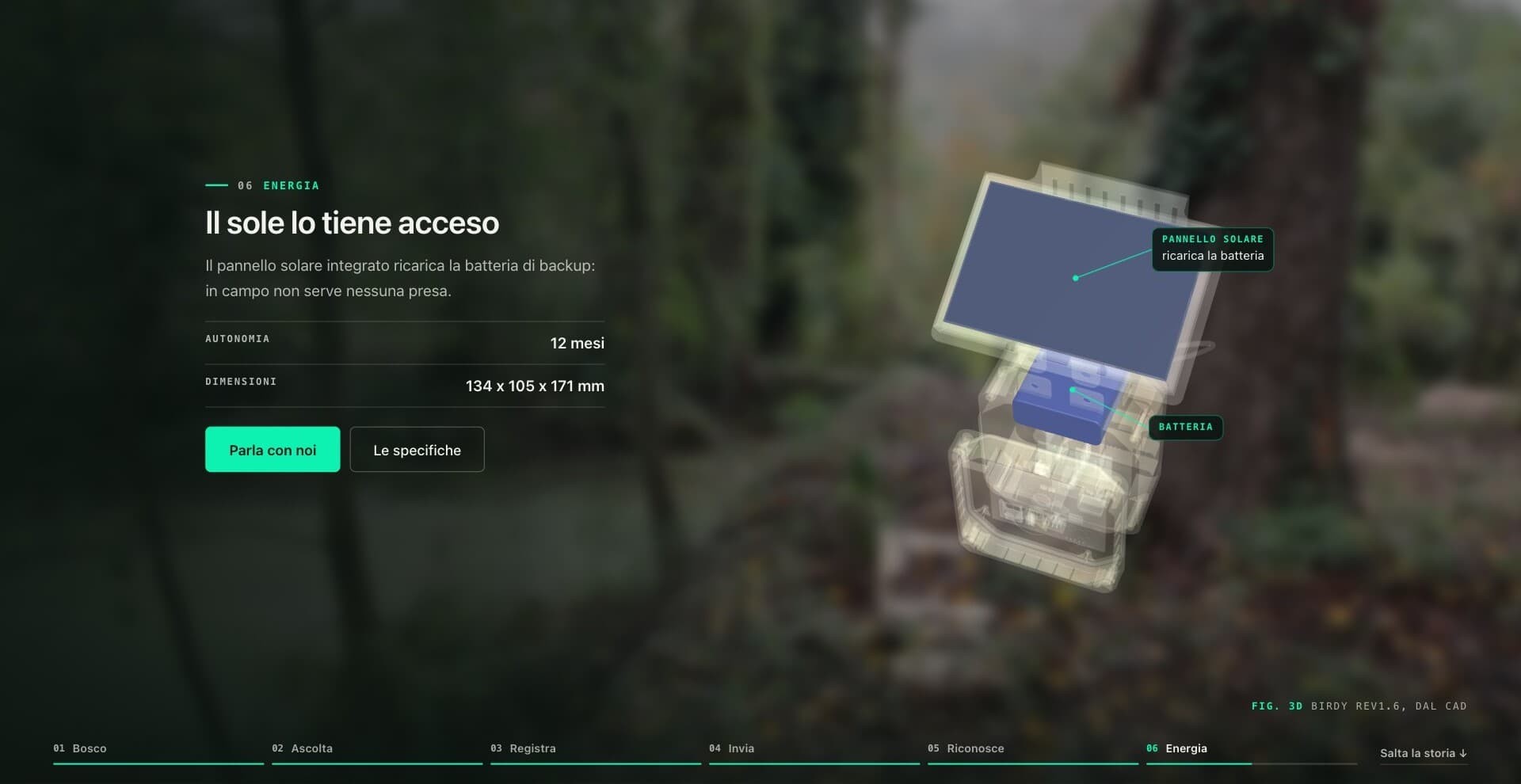
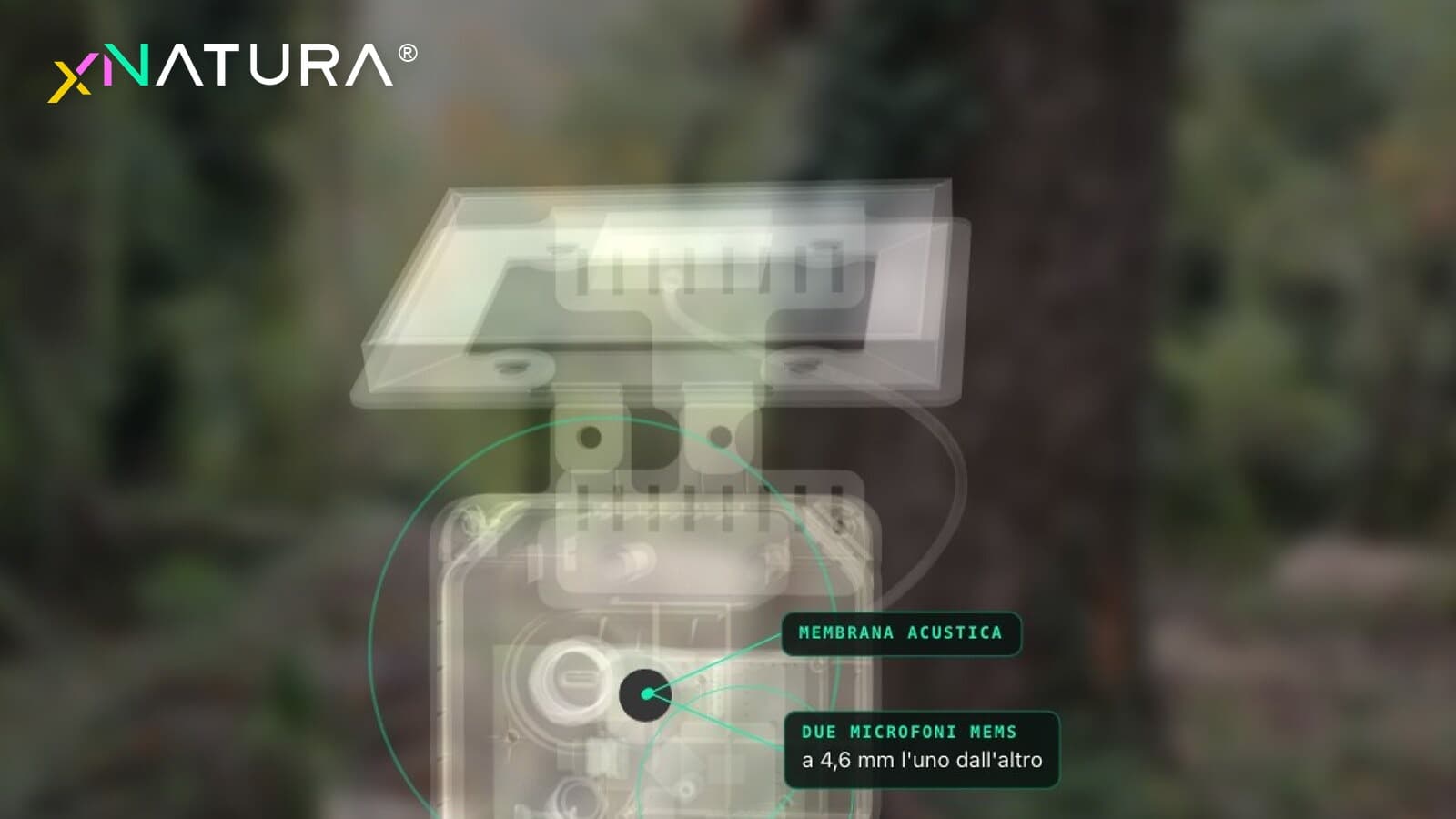
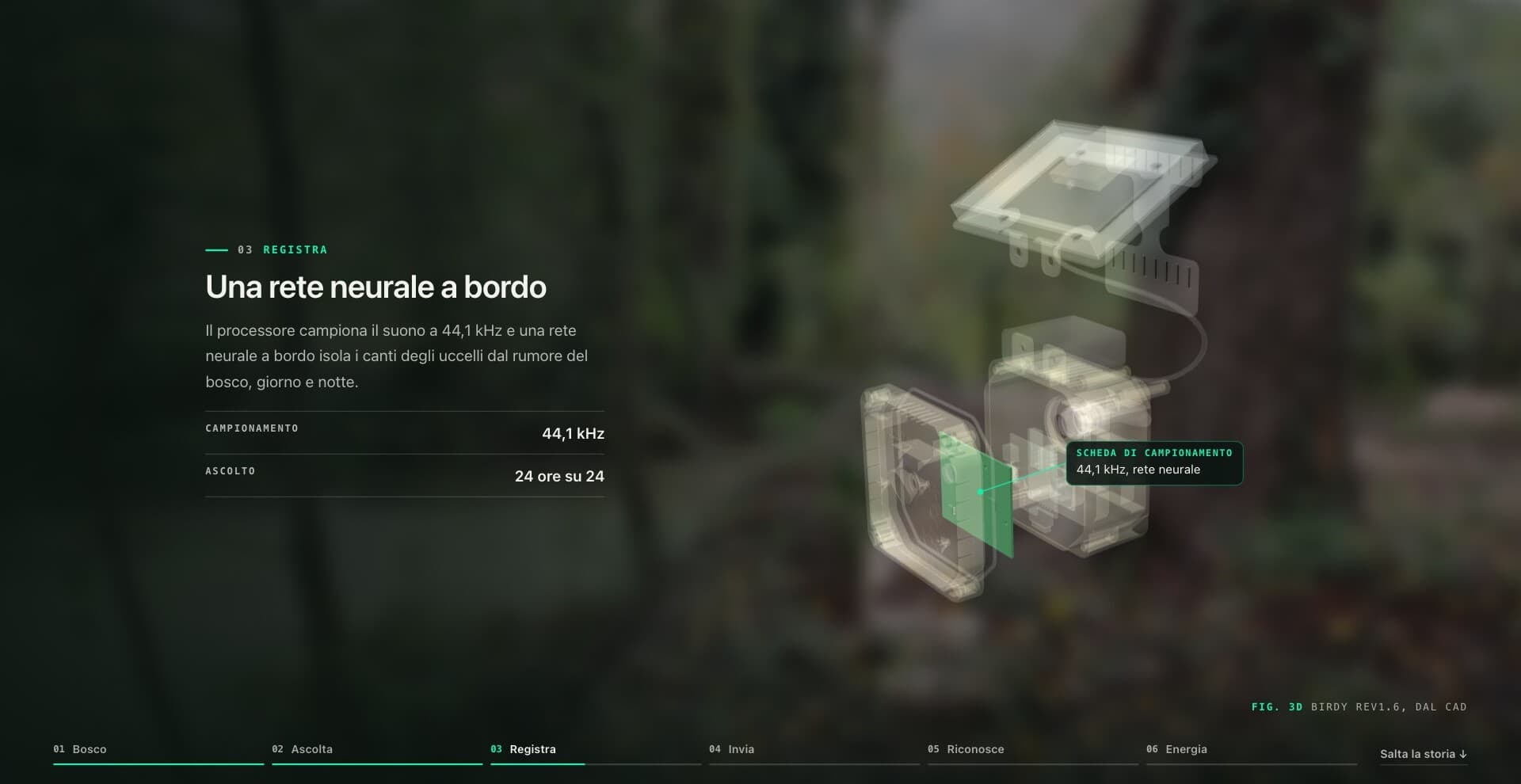
    Inside a compact casing measuring 134 x 105 x 171 mm, Birdy has two MEMS microphones 4.6 millimeters apart, protected by an acoustic membrane in the front cover: birdsong gets in, rain doesn't. The microphones cover frequencies from 20 Hz to 20 kHz. The processor samples sound at 44.1 kHz, and an onboard neural network separates bird songs from forest noise. A 4G/LTE board with GPS transmits data without Wi-Fi or network cables, and an integrated solar panel recharges the backup battery, with 12 months of autonomy in the field: no power outlet, no technician coming by to download memory cards.

    Birdy in 3D: la scheda di campionamento con la rete neurale a bordo
    XNatura

    How it works: from song to species

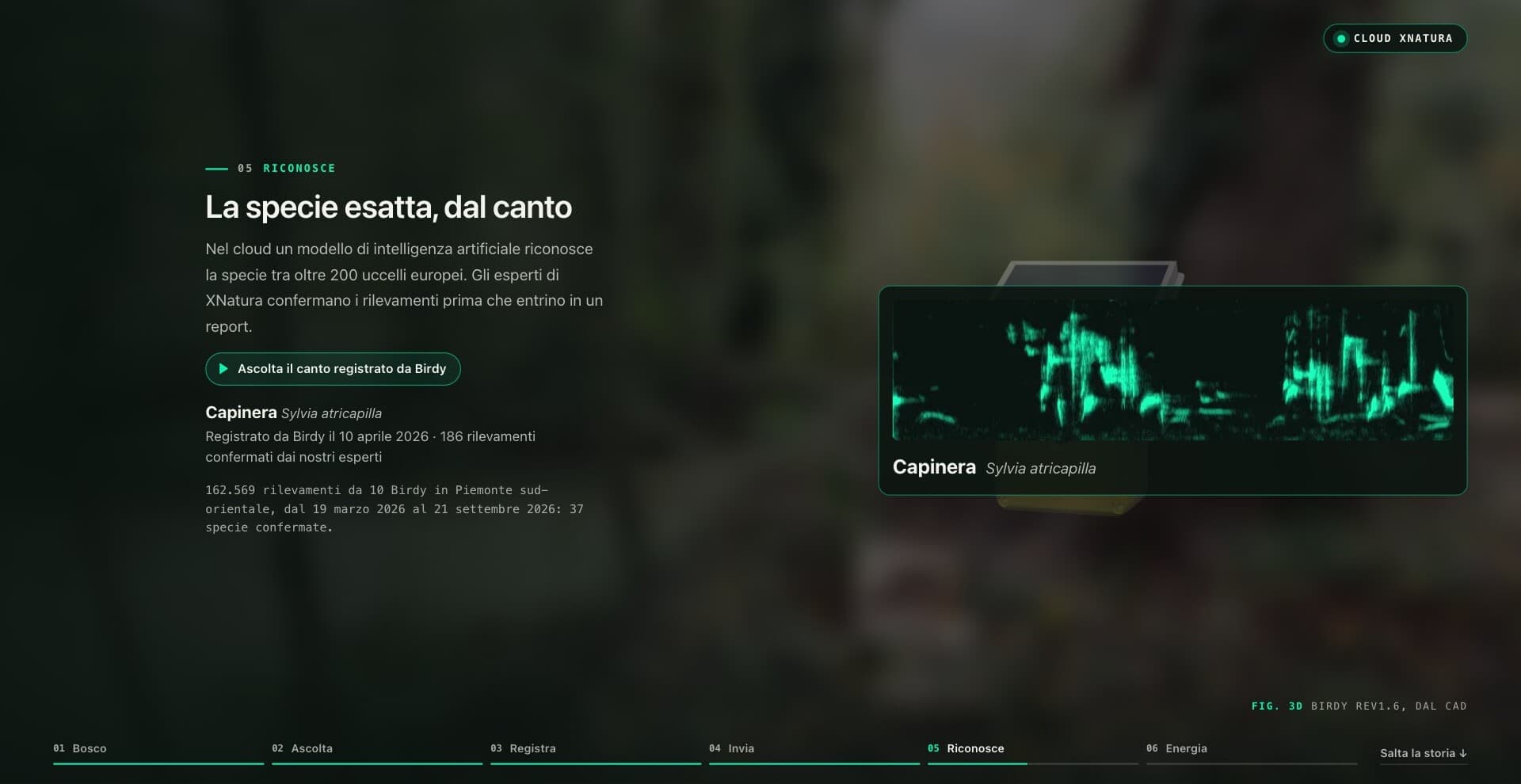
    Birdy listens 24/7. When the onboard neural network isolates a song, the sensor sends the recording to the XNatura® platform. In the cloud, an artificial intelligence model, trained by us on the sounds from our sensors, recognizes the species among over 200 European birds and checks whether it is plausible in that place: a species outside its range is not hidden, it is flagged. Our experts confirm the detections before they enter a report. On the platform, for each site you can find the list of species, the spectrogram and the audio of each song, alongside data from Spectrum on pollinators, from camera traps and from satellite maps. In the video you can listen to three real songs recorded by Birdy: a blackcap, a blackbird, and a nightingale.

    video cover

    Why it goes beyond BirdNET

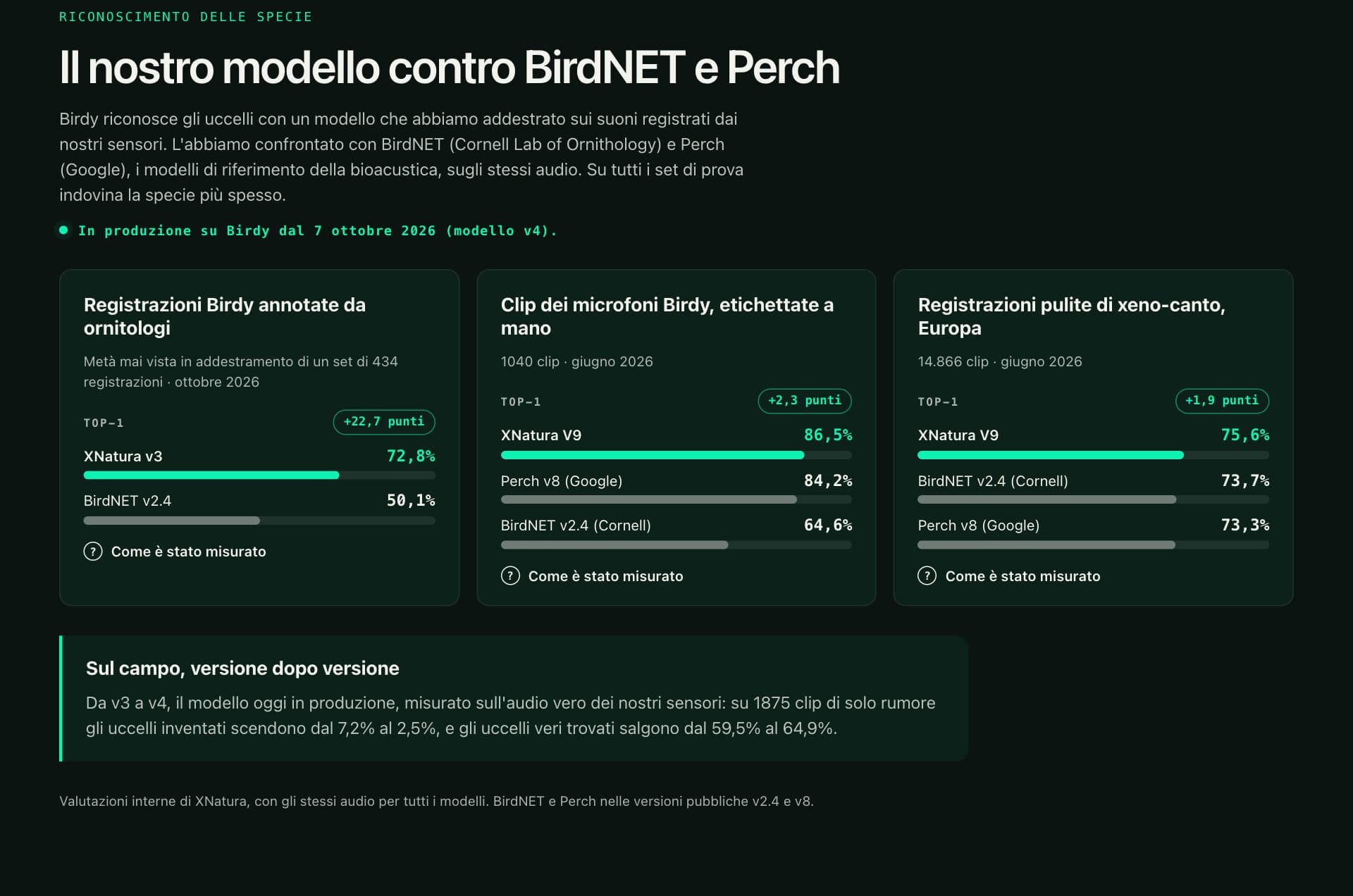
    BirdNET, from the Cornell Lab of Ornithology, is the benchmark model in bioacoustics and excels on clean recordings made with professional microphones. A field sensor, however, hears other things: wind, rain, traffic, distant songs. That is why we trained our model on the sounds from our sensors and compared it on the same audio. On 434 Birdy recordings annotated by ornithologists, it identifies the species on the first try in 72.8% of cases, versus 50.1% for BirdNET. On 1,040 clips from Birdy microphones, it reaches 86.5%, versus 64.6% for BirdNET and 84.2% for Google's Perch. Even on clean xeno-canto recordings, BirdNET's home turf, it stays ahead: 75.6% versus 73.7%. And with version 4, in production from October 7, 2026, birds hallucinated from noise alone dropped from 7.2% to 2.5%. These are internal evaluations, using the same audio for all models: details are on the Birdy page.

    Il modello XNatura di Birdy a confronto con BirdNET e Perch
    XNatura

    How to get it: within an XNatura® project

    Birdy isn't bought off the shelf and you won't find it in an online store: it comes with an XNatura® project, sized to your site. Our team chooses with you how many sensors are needed and where to place them, activates them on the platform and monitors the data, which feed into surveys, ecological baselines and reports ready for ESRS E4, Biodiversity Net Gain and permits, signed by our ecologists. Birdy works on its own or together with Spectrum, camera traps and satellite maps, so birds, pollinators, wildlife and land are all in one place. If you want to bring it to your sites, tell us about the project: we'll reply with a tailored proposal.

    Birdy in 3D con il pannello solare e la batteria
    3Bee
    20/10/2026Of 3Bee, Niccolò Calandri
    5 Views
    Newsletter
    newsletter
    Subscribe to the Blog about bees and biodiversity