Barbie Pig really exists. And it lives 5,000 metres under the sea.
    Who is Barbie PigFive hours downThe 0.001%Know first

    Barbie Pig really exists. And it lives 5,000 metres under the sea.

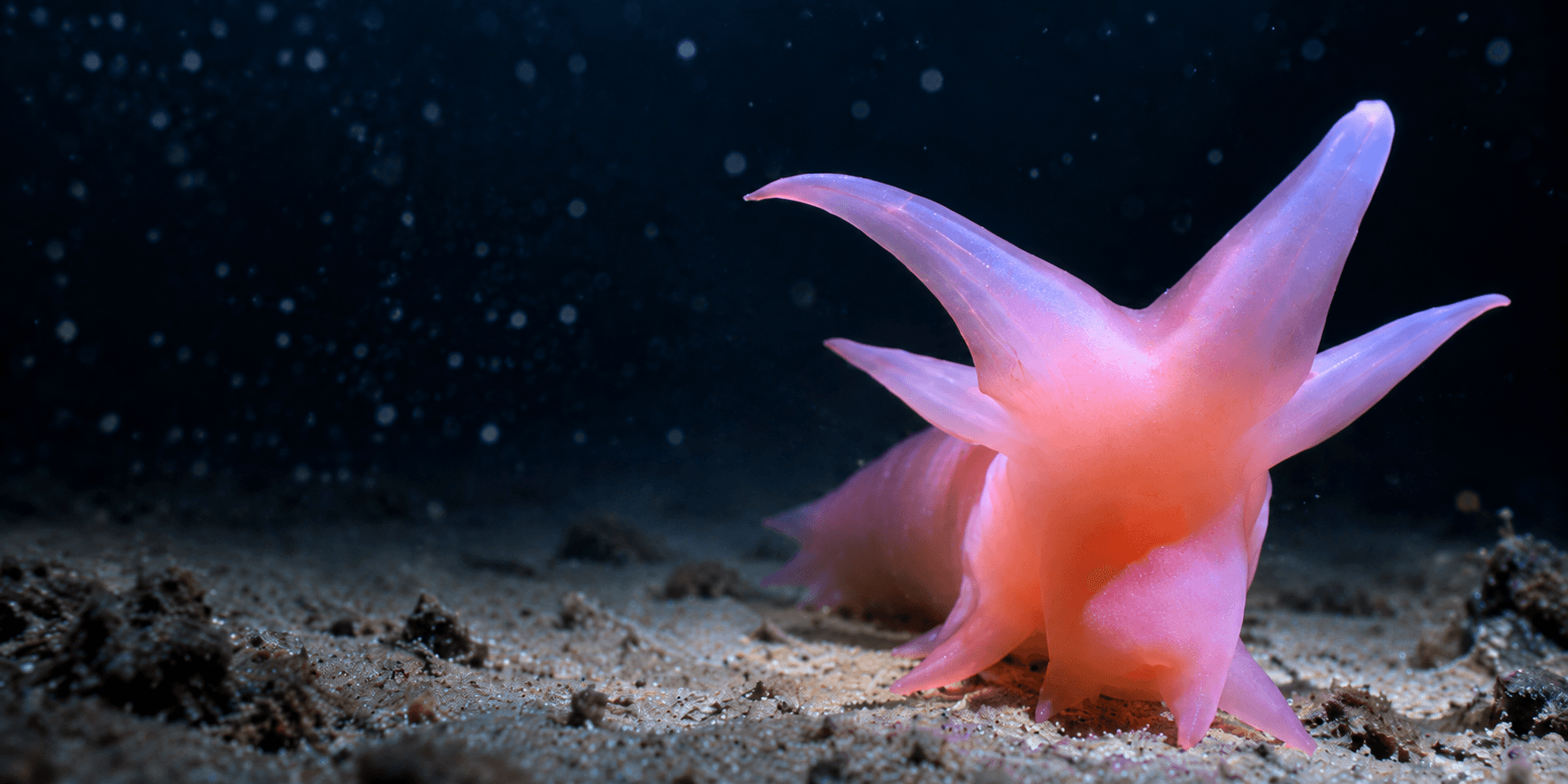
    No, it isn’t the new character from an animated film: Barbie Pig is the nickname of a pink creature observed at 5,000 metres deep in the Pacific Ocean. It is a sea cucumber, and its species has not yet been described by science. It tells us how little we know about the deep sea.

    Read the article
    08/10/2026Of 3Bee, 3Bee
    8 Views
    08/10/2026Of 3Bee, 3Bee
    8 Views

    No, it isn't the new character from an animated film.

    No, it's not the new character from an animated film.

    Barbie Pig is the nickname researchers gave to a particular pink creature observed at a depth of about 5,000 metres in the Pacific Ocean.

    It is a sea cucumber: a holothurian, a relative of starfish and sea urchins. Its species has not yet been formally described by science. This means it does not yet have a scientific name, nor a profile that recounts its habits, ecological role and distribution.

    Barbie Pig is one of the protagonists of How Deep Is Your Love, the documentary that recounts a scientific expedition in the Clarion-Clipperton Zone, a vast area of the Pacific that stretches between Hawaii and Mexico. A place that, seen up close, resembles another planet more than our own.
    No, it isn't the new character from an animated film.

    Five hours of descent to reach the seabed

    To reach those depths, the underwater robot used by researchers takes around five hours. Five hours of descent in the dark, before it even begins to observe anything.

    And what it finds down there has an appearance we find hard to imagine. Besides Barbie Pig, scientists have encountered organisms with equally improbable nicknames:
    • Headless Chicken Monster, a sea cucumber that swims and really does resemble a headless chicken
    • Psychedelic Elvis Worm, a marine worm that owes its name to its shimmering scales, worthy of a stage costume
    The nicknames are not just a nice touch: they are needed because for many of these creatures a scientific name does not yet exist. We call them that because it is the only way we have, for now, of talking about them.
    Five hours of descent to reach the seabed
    XNatura

    We have seen 0.001% of the deep ocean floor

    According to an estimate reported by the Guardian, we have directly observed just 0.001% of the deep ocean floor.

    That number is worth pausing on for a moment. The oceans cover more than 70% of the planet’s surface, and most of their volume is deep water. Of all this, we have looked at—with our own eyes or through those of a robot—a fraction written with three zeros after the decimal point.

    Every descent brings home new species, and that is not just a figure of speech: on deep-sea expeditions, the share of organisms not yet described is often the majority of those observed.

    It is a fact that tells us better than many speeches how much there still is to discover about the biodiversity of our planet, and how young our knowledge of our own home is.

    We have seen 0.001% of the deep ocean floor

    Know before transforming

    The same area is today at the centre of the debate on deep-sea mining, the extraction of minerals from the deep sea: the seabed of the Clarion-Clipperton Zone is covered in nodules rich in nickel, cobalt and other minerals useful for energy transition technologies.

    A question therefore arises that is worth holding on to:

    how can we decide what to transform, what to use and what to protect, if we do not first really know what is there?

    It is a subject that concerns the deep sea, but not only. It also applies on land, in meadows, woods and farmland near home. Knowing biodiversity means first of all observing it, measuring it and collecting data over time: not just once, but continuously.

    Because what we do not know is also much more difficult to protect.

    Source: The Guardian, Meet Barbie Pig. Further reading: Natural History Museum and Rabone et al., Current Biology. Cover image generated with artificial intelligence.

    XNatura
    08/10/2026Of 3Bee, 3Bee
    8 Views
    Newsletter
    newsletter
    Subscribe to the Blog about bees and biodiversity