Aethina Tumida: What it is, How to recognise it, What to do
    What it isBiological cycleRecognising itSearch

    Aethina Tumida: What it is, How to recognise it, What to do

    Aethina tumida Murray, also known as Small Hive Beetle (SHB), is a hive pest that gives rise to a particular disease, Aethiniosis, which must be reported. This parasite originates from South Africa and in some areas of cont

    Read the article
    15/02/2018Of 3Bee, Elena Fraccaro
    1422 Views
    15/02/2018Of 3Bee, Elena Fraccaro
    1422 Views

    Aethina Tumida: What it is, How to recognise it, What to do

    Aethina tumida Murray, also known as Small Hive Beetle (SHB), is a hive pest that gives rise to a particular disease, Aethiniosis, which must be reported. This parasite originates from South Africa and coexists with Apis mellifera scutellata and Apis mellifera capensis in some parts of the African continent without any particular problems. Indeed, the latter seems to have developed a particularly aggressive attitude towards the parasite, which only manages to get the better of the hive when it is already weak and in poor condition. The problem arises when Aethina tumida makes its appearance outside its 'natural habitat'. In 1996, it was detected in the USA. After two years, it had already created considerable damage in Florida, quantified at around $3 million. From there, it then spread throughout the United States, to Egypt, Australia and Canada. In 2004, it was detected in Portugal, the first report in Europe. In Italy, it made its appearance in 2014 first in Calabria, in Gioia Tauro, and in Sicily, in Melilli. Following these findings, the Ministry of Health took action to destroy infected hives and to monitor the spread of the parasite through specific national surveillance plans. This monitoring activity, confirmed also for 2021, involves randomised cyclical checks based on specific risk calculations.


    The biological cycle of Aethina tumida

    Aethina tumida is a beetle that normally lives in beehives, where it can retrieve food and protection from external threats. Adults are 5 to 7 mm long and 3-4.5 mm wide, brownish-black in colour. They generally live 4-6 months, overwintering inside the glomerulus itself. They move from hive to hive attracted by the smell of bees and honeycomb containing pollen and brood. Once inside a new hive, the females begin to lay eggs, which hatch within a maximum of six days. It is the larvae that do the most damage to the hive because, by digging through the wax in search of food, be it honey, pollen or brood, they compromise the combs and the faeces left along their path lead to the fermentation of honey. In fact, one of the telltale signs of the presence of the parasite is the smell of rotten oranges, typical of fermented honey, that spreads when the hive is opened. Having developed to a size of around 11 mm, they emerge from the hive and penetrate the ground for their next stage of development, which sees them transform into pupae. After 3-4 weeks they emerge as adults, mate and re-enter the hives, going through the various stages of their biological development. The entire cycle can vary from a minimum of 27 to a maximum of 84 days. The perfect conditions for pupa development involve moist, soft soils and temperatures above 10°C. However, they can also survive in drier soils and lower temperatures for up to 3-4 weeks. Adults can fly up to 10 km to infest a new hive and, without food and water, survive up to 9 days. On used combs, they live up to 50 days, while on fruit, even several months. These characteristics, plus the fact that they overwinter inside the glomerules of apoids, make it very easy for them to spread. Movements of bee packages, colonies, swarms, honey in combs, wax, soil and fruit are the main vehicles for spreading the parasite.

    XNatura

    How to recognise Aethina tumida

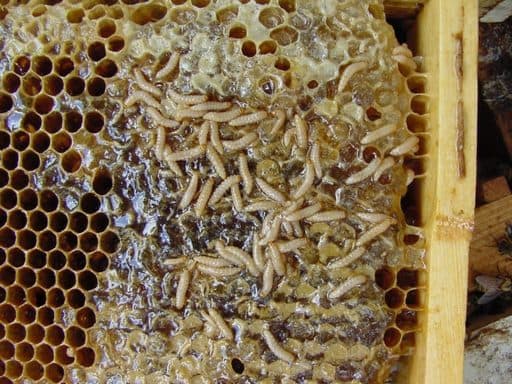
    What are the distinguishing marks that enable one to recognise this dangerous pest? Particular attention must be paid to the larvae. At first sight, in fact, it could be confused with the larvae of the wax moth. It appears in fact with the same colour (cream) and size (about 1 cm). The distinctive features are visible upon closer observation. The larva of A. tumida has three long front legs, spines along its back and two larger ones at the back. The distinctive features found in the adult, on the other hand, are the section of abdomen left uncovered by the structure covering the wings and the characteristic club-like antennae. The damage caused to colonies is varied. The fact alone that European subspecies of Apis mellifera have no defence against it makes A. tumida extremely dangerous. The more larvae inside the hive, the greater the damage. High levels of infestation lead to the interruption of oviposition activity or to the bees abandoning the hive or even to the collapse of the family. Obviously, the weaker the family, the more severely it is affected by this pest. The honeycombs and the honey itself are also damaged by the presence of Aethina tumida. As has already been mentioned, the presence of larvae faeces leads to fermentation of the honey, which is no longer consumable by humans.

    Methods of parasite research

    Careful examination of the hive can reveal whether there is an Aethina tumida infestation before it spreads to the point where neighbouring hives are endangered. Currently, this can be done through visual examination, the use of special traps or by sending samples to analysis laboratories. Visual examination is basically based on inspecting the inside of the hive, the inner walls, the most inaccessible places, individual nest combs and the removable bottom of the box. Another method involves placing the honeycombs on the coverlet for about a minute. Once they have been removed, it should be carefully observed whether there are any pests trying to escape to the bottom, shunning the light. The use of special traps may be more useful in the early stages of infestation, when a visual inspection may not be effective or even fallacious. One of the most common traps consists of a strip of cardboard or corrugated plastic with gaps of 3-4 mm. This is inserted at the bottom of the hive and removed periodically to see if A. tumida specimens are present in the interior spaces. Another trap is the one known as the Beetle Blaster. This is nothing more than a plastic tray with holes that only allow access to the A. tumida. Two trays are inserted for each hive, one between the first and second honeycomb and the other between the penultimate and last. They are then filled with wine or apple vinegar, but also with vegetable oil. These substances attract the parasite, which is thus enclosed in the trap. Currently in Italy, all infected or presumed infected hives are still eliminated. This is why proper surveillance and rapid intervention in the event of infestation is essential to prevent the spread of the dangerous parasite. In other countries, such as the USA, forms of chemical control are implemented that involve the use of insecticides, which can however cause episodes of drug resistance. Another avenue that is being pursued is the reclamation of the area surrounding the hive. Methods that have the least possible impact on the environment are currently being sought. Forms of biological control are studying the effectiveness of using nematodes, preparations based on entomopathogenic fungi and certain inorganic substances. Finally, forms of mechanical pest control are also being tested, involving modifications to the hive entrance step. However, it is not yet certain what repercussions this may have on the hive and its productivity.

    XNatura
    15/02/2018Of 3Bee, Elena Fraccaro
    1422 Views
    Newsletter
    newsletter
    Subscribe to the Blog about bees and biodiversity
