Game Of Thrones (Of Bees)
    GameStudioColonieUnder siege

    Game Of Thrones (Of Bees)

    It is certainly no mystery that life inside the beehive is ruthless. We know that a newborn virgin queen has to conquer her 'throne'. The Game Of Thrones (Of Bees). Find out in our article

    Read the article
    10/02/2021Of 3Bee, Elena Fraccaro
    407 Views
    10/02/2021Of 3Bee, Elena Fraccaro
    407 Views

    Bees protagonists of the Iron Throne?

    This kind of dynamic, however, is fairly well known among insiders. What is perhaps a little less well known is the subject of a study conducted in Australia on a particular species of stingless bee, Tetragonula carbonaria. What Dr Cunningham, head of the research team, witnessed prompted him to exclaim: "These bees are playing the throne of swords!". What could have prompted such an observation? And what does playing throne of swords mean? .

    An Australian study

    The results collected by Dr Cunningham's team were published in the American Naturalist Journal and encapsulate work that lasted from 2008 to 2012 and involved several colonies of Tetragonula carbonaria and Tetragonula hockingsi, two species of stingless bees widespread in Australia. In the ant world, fatal battles between neighbouring colonies are very common and well documented. In the world of bees, something a little different happens. What is known is that fights in the vicinity of places where bees collect nectar and pollen are more common. Usually these deadly confrontations are engaged in by the sterile worker bees, whose sacrifice benefits the survival of the entire hive. Other confrontations may occur when a colony has to choose the best place to settle.

    XNatura

    Clashes between colonies?

    On the other hand, it is more difficult to witness actual attacks on nests. To date, Tetragonula carbonaria is the only species known to engage in clashes between colonies, one besieging and one besieged. These are real battles to the death and result in heavy losses on both sides. The hypothesis of scholars is that the cause of these events must be sought in the desire to usurp the nest of the besieged colony. Continue reading

    A colony under siege

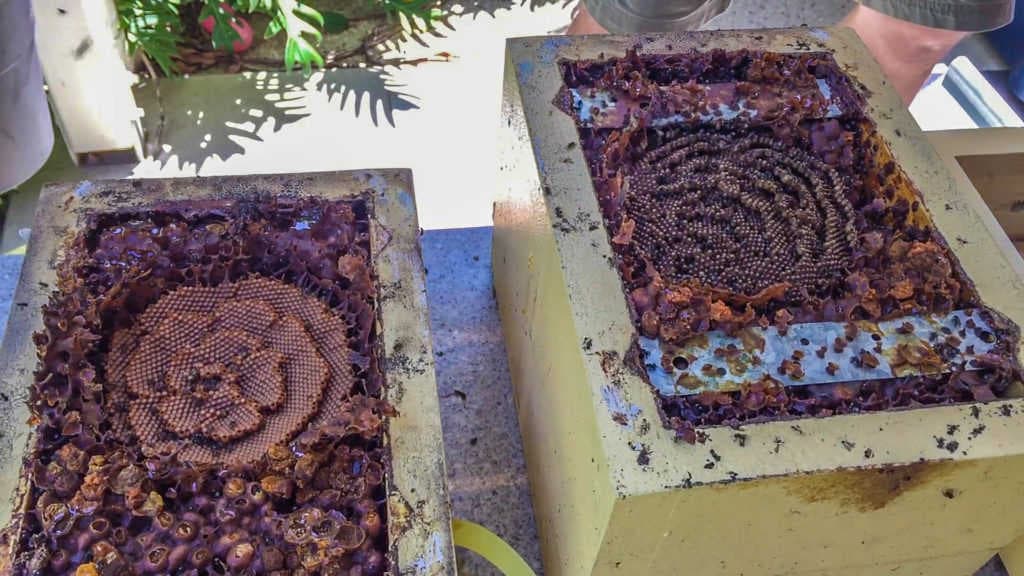
    What prompted the focus on these bees was the frequency with which swarm fights could be witnessed. T. carbonaria are used to building nests in logs or cavities of various kinds and are widespread in the Brisbane area. The researchers monitored a colony 'under siege', which suffered several attacks by members of a T. hockingsi colony over the course of four months. The researchers then found that the besiegers had outnumbered the besieged colony and that the 'victors' had begun to transport the defeated bees out of the nest. After a few months, they opened the nest and discovered something incredible.

    XNatura

    An interesting discovery

    On a genetic level, the new queen was found to be descended from the besieging family and the structure of the nest itself had also changed. A real case of usurpation had occurred. To corroborate their thesis, they then extended the study to 260 different families. In five years, they recorded no less than 46 similar cases. This leans in favour of the hypothesis that this kind of behaviour is more common than people think. Surprising isn't it? Continue reading below

    3Bee

    Game of Bee Thrones?

    Professor Ratnieks (University of Sussex) looked with interest at the study conducted in Australia. An expert on bee behaviour, he also drew attention to what happens in South America, where bee species specialising in stealing honey and resources from other hives, which are decimated in the process, are widespread. One can therefore understand why the life of these insects has been compared to the famous TV series. The bees engaged in a real fight to the death for supremacy. What if it was George R.R. Martin who took his cue from the bees to build his fantasy universe?.

    10/02/2021Of 3Bee, Elena Fraccaro
    407 Views
    Newsletter
    newsletter
    Subscribe to the Blog about bees and biodiversity


