Hive Diseases: The American Plague
    CauseActionSintomiDiagnoses

    Hive Diseases: The American Plague

    Among the diseases affecting broodstock, one of the most widespread and certainly the most serious is American foulbrood. Not to be confused with European plague, this disease has unmistakable distinguishing features and, once diagnosed, it is difficult to save the family.

    Read the article
    07/06/2022Of 3Bee, Elena Fraccaro
    751 Views
    07/06/2022Of 3Bee, Elena Fraccaro
    751 Views

    The causes of the American plague

    It is caused by a sporigenous anaerobic bacterium, Paenibacillus larvae, which affects larvae in the first days of life. The spores of this bacterium are very resistant and can remain viable for up to 30-40 years. They are also highly resistant to heat (subjected to a temperature of 100°, they perish only after about 30 minutes) and other substances. Their main target is the larvae in their first 24 hours of life. The spores, in fact, only germinate in the gut of the larvae as the latter have neither mechanisms nor substances to inhibit their development. The younger the larva, the fewer spores are needed to infect it: 10 are needed in the first 36 hours after birth, but in larvae 4-5 days old, more than 10 million are needed
    How does it work?

    Within 24-48 hours after penetration of the spore, it completes its germination, transforming into a bacillus. Within 7 days, the infected larva dies, usually in the mature larva, prepupa or pupa stage. Once the death of the larva occurs, the family can actually be considered to be diseased, as the larva contains numerous spores (around 3 million) that will then be spread throughout the hive. It has been calculated that around 50 million spores are needed to infect a family, although a strong family, not subjected to stress of any kind, may well not become sick unless it comes into contact with a disproportionate number of spores (up to 300 billion!) [Contessi, 2016].

    XNatura

    Symptoms

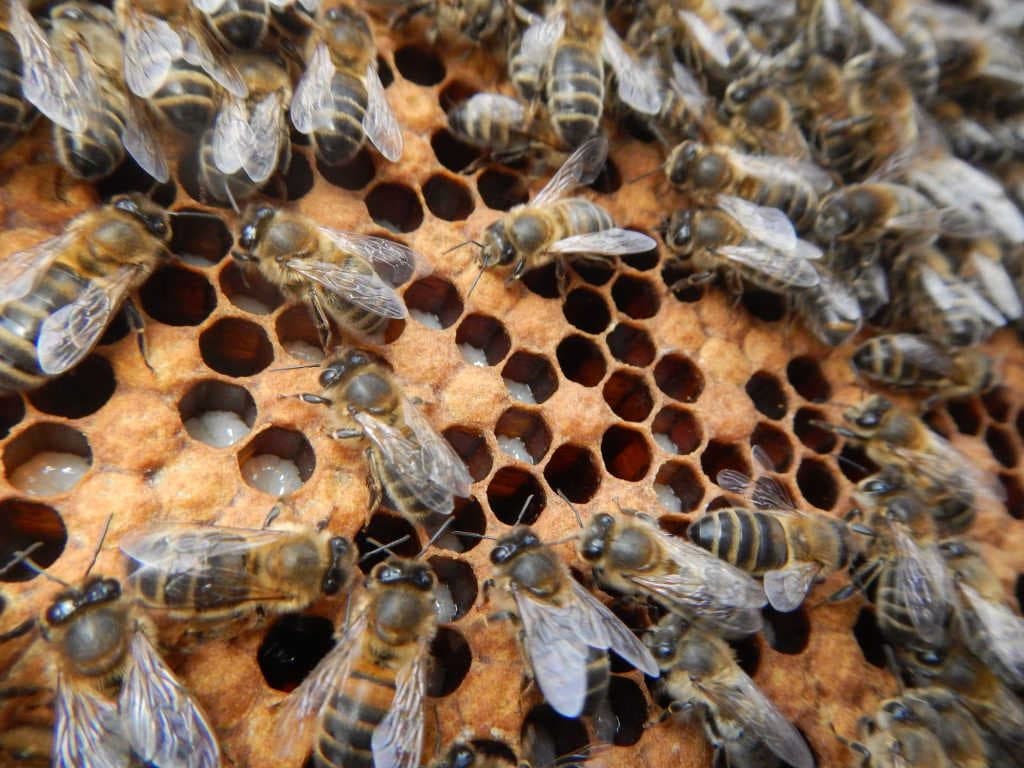
    The symptoms that allow one to recognise this serious disease are quite clear and, although most diagnoses are made by visual inspection of the family, one can also use specific kits available on the market or resort to laboratory analyses. Being a brood disease, it is precisely this that needs to be analysed to see whether we are dealing with a real case of American foulbrood. First of all, the brood appears non-compact, with darker or sunken opercula or even perforated in their centre. Another element that is immediately noticeable is the smell, described as sour, fetid and of putrefaction. The larvae lose their normal pearly colouring to become first yellowish and then dark brown, with a slimy consistency. In the course of 6-7 weeks, the dead larva dries out, presenting itself in the form of a black scale attached to the cell wall.

    How to Diagnose

    Once these symptoms have been noted, one must ascertain the diagnosis. The most common test is the 'toothpick' test. It consists of inserting a toothpick inside the cell containing a dead larva. If a hazel-coloured filament emerges when it is pulled out, with an elastic consistency that can stretch up to a few centimetres, then one really does have American foulbrood. Other diagnostic tools can be kits or the use of laboratory analyses, which can give a sure verdict. Once you are certain that you are dealing with a hive infected with this disease, you must proceed to report it to the competent health services (ATS).

    XNatura

    Transmission

    How is this disease transmitted? Within the hive, contagion occurs via the worker bee. By cleaning spore-laden cells, they become vectors of the disease, spreading it throughout the hive. In this way, the nurse bees feed the larvae with infected food, contributing to the spread of the disease. Spores may be naturally present in the hive, but if they are small in number and the family is strong, the disease may not manifest itself. The problem emerges when huge quantities of spores are found in the hive. The methods of transmission are varied. Firstly, care must be taken when transferring materials (hives, combs, honey), especially combs containing dead larvae or pupae. Next, one of the main causes of contagion is identified as looting, especially by strong families attacking weaker sick families.

    3Bee

    Beekeeper

    Another factor in the spread of spores is certainly the use of infected bee packages or the purchase or recovery of infected swarms of dubious origin. The beekeeper also plays a crucial role in this phenomenon. The use of contaminated beekeeping equipment can also lead to infection of other families, as can the feeding of honey and pollen containing spores. This is why it is advisable to disinfect equipment periodically and to feed one's bees either with food of certain origin, of which one can be sure, or with syrups and candied fruit prepared with industrial sugars. Finally, the phenomenon of drift can also contribute significantly to the spread of spores, even if it is not identified as one of the main causes.

    Risk factors and prevention

    One must also consider certain risk factors that should be avoided to try to control the spread of this disease. It is not good practice to retrieve abandoned hives whose origin is unknown and that may be vectors of various diseases. In addition, the periodic change of combs and also that of queens is strongly recommended, especially if they have shown a greater genetic susceptibility to the disease. In terms of prevention, periodic health checks are recommended, so as to detect the disease when it is not yet extremely widespread. It is also advisable to respect good beekeeping practices, avoiding becoming a vector of contagion or facilitating it.

    Cures

    Good prevention is often the only way to deal with this disease. There is, in fact, no officially recognised cure, although treatment of the disease with various types of substances is widespread. These, however, do not solve the problem, but only partially contain it, risking a subsequent relapse with a greater outbreak of the disease and, therefore, a more widespread contagion of the apiary. Generally, once American foulbrood has been diagnosed, the colony is completely eliminated with fire and the infected material (hive, equipment, etc.) sterilised.

    The "cura famis

    One practice, however, that is adopted to try to save the adult bees of a colony is the so-called 'cura famis'. This consists in transferring adult bees (with caged queen) into sterile hives, with unbuilt wax sheets, where they are closed for a few days without feeding, giving them the opportunity to consume all the infected honey contained in their honeycomb bag. After a few days, the bees are removed to another sterile hive with new wax sheets and everything they have built up during the 'confinement' period is removed. This must usually also be followed by the replacement of the queen, to prevent the development of subsequent brood that is particularly susceptible to the bacteria.

    ....

    However, this practice is not particularly effective. In addition to only being carried out with strong families that have a chance of recovering, and at times of the year favourable to family development, it is very costly in terms of time and money, as well as requiring particular dexterity and care, otherwise the contagion will spread. For these reasons, to date the only truly safe method of dealing with American foulbrood is through the elimination of the infected family and the subsequent sterilisation of all material that has come into contact with it. This procedure, although difficult to accept, allows the containment of the disease and the preservation of other families.

    Monitor the health of your bees in real time

    Timing is therefore of paramount importance. Detecting the onset of this disease in time may not save that family, but it will prevent you from infecting and losing all other neighbouring hives, including those of neighbouring beekeepers. Discover the benefits of real-time remote monitoring to keep an eye on your bees at all times! Get 3Bee devices, protect your bees with technology and constantly monitor the health of your bees.

    07/06/2022Of 3Bee, Elena Fraccaro
    751 Views
    Newsletter
    newsletter
    Subscribe to the Blog about bees and biodiversity